|
|
|
|
Young Inventors Program (YIP)
|
| YIP brings together young creative minds and the experience of seasoned experts in a multidisciplinary learning environment. Mentors are teamed with students from universities, high schools, and community colleges, and assigned technical projects to develop green inventions while receiving practicum credit from their home institutions. YIP is currently focused on the development of a hand fed version of the StrawJet for the developing world. ASET provides students with a set of skills, an enhanced ability to solve problems, and a sense of enthusiasm and self worth that comes from making a meaningful contribution to the world. The program was initiated in the fall of 2005 and currently includes 10 mentors and 13 interns working on 7 different projects. |
|
The Loom Project
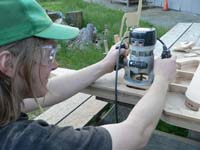
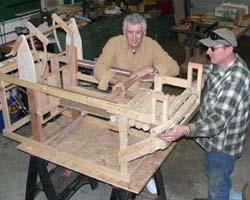
A prototype loom was developed to weave the straw cables into a mat for use in constructing wall panels. The loom project is continuing with the building of a full size loom to weave 8 foot lengths of cable for a standard 8 foot high wall. Eventually the loom would be fully mechanized and travel through the field making cables into mat as it goes. (see: How it Works)
|
 |
|
Alan Gale and Bruce Harshman
|
|
The Matrix/ Binding Project
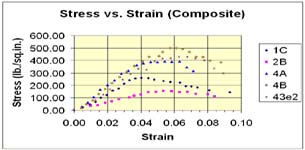
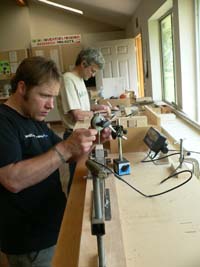
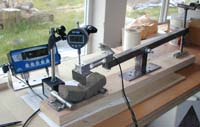
Originally two separate projects, they are now merged. The matrix project is responsible for developing the material used to bind the straw cables and straw mats together. The team is investigating ways to increase the adhesion of the material to the straw which is quite slippery, and ways to increase the internal strength of the clay, soil, paper pulp mix used as the base for the matrix material. The team has constructed various test apparatus to enable it to take the measurements, and has produced an extensive data base.
|
|
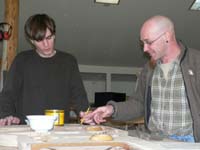
| Aaron Lazelle & Norton Smith Testing tensile strength of a matrix material sample |
 |
|
|
|
|
|
|
Alternate Fibers
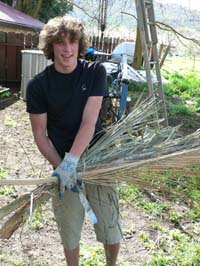
The group is researching alternatives to straw. Palm fronds may work well in tropical areas, fibers such as hemp and flax may be best for structural elements, while plant such as Jerusalem artichoke provide excellent insulation.
As samples of plant material are obtained the team is producing cables for testing.
|
 |
|
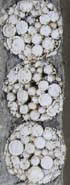
Jerusalem artichoke
|
|
|
David Chambers collecting |
|
|
|
|
 |
Mold Suppression
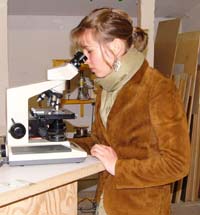
One of the limitations of the process is the need for good drying weather to remove the moisture from the straw and matrix material incorporated during the manufacturing process. Studies of ways to reduce the formation of mold during damp conditions would extend the manufacturing season later into the fall, and would allow the technology to be used in damper climates.
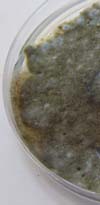
In addition to investigating non toxic ways to reduce mold in straw, the team is testing alternative fibers for their natural resistance to mold.
|
 |
|
Natalie Jablonski
|
Straw mold
|
|
|
|
|
|
ASET is grateful for the participation of all the team members during the first year.
|
Mentors
|
Interns
|
- David Pyles
- Larry Pearson
- Chaz Brown
- Vicki Tripoli
- Alan Gale
|
- Leo Palombo
- Greg Cary
- Steve Coffman
- David Ward
- Norton Smith
|
- Kelly Gustafson
- Nathan Turner
- Travis Marshal
- Natlaie Jablonski
- Dillon Martin
- Ebn Wandell
|
- Alyssa Grove
- Nathen Meyerson
- David Chambers
- Aaron Lazelle
- Gwyn Myer
- Carrie Clayton
-
|
|