Ashland School of Environmental Technology


Home

StrawJet Project

Young Inventors Program

How it Works

Photo Gallery

Videos

News

Summer 2006 Newsletter (PDF)
Download 627KB
Spring 2006 Newsletter (PDF)
Download 1.3MG

Support ASET

Strawjet Inc.

Frequently Asked Questions

Overview Flyer (PDF)
Download 121k

Contact Us

Milestones for 2006

The Modern Marvels Invent Now Challenge names David Ward and the StrawJet Project the winner. The StrawJet technology was selected from 4,300 entries as the "Modern Marvel" of the year. The Challenge is sponsored by The History Channel and Invent Now Inc., a subsidiary of the National Inventors Hall of Fame Foundation. For more information and a full press release go to: http://www.history.com/minisites/invent/viewPage?pageId=51464

Other references:

Popular Mechanics - http://www.popularmechanics.com/blog/science/2877976.html

Time Magazine - http://www.time.com/time/nation/article/0,8599,1198056,00.html

Milestones for 2005
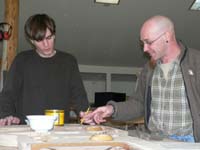
Mentor Leo Polombo and intern Travis Marshall
The Young Inventors Program was established in April 2005 with a generous grant from the Meyer Memorial Trust. The current program brings together 13 students with 10 mentors working on 7 projects associated with adapting the Strawjet technology to the developing world, and to the production of disaster relief shelters.

StrawJet Inc., a for profit corporation, was established in March 2005 to complete the development of the harvester and market the technology. StrawJet Inc. received a grant from the Environmental Protection Agency through the Small Business Innovation Research Program to develop the current prototype shown in the photo gallery.

ASET is refocusing its attention on developing a hand fed version of the harvester and experimenting with alternative fibers that would be available in non wheat growing regions, and/or have sufficient strength to build beams to support roof structures.

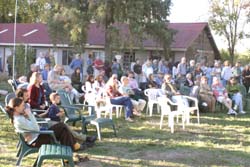
Open House: ASET kicked off a fundraising campaign and welcomed local supporters too the remodeled shop. Attendance was exceptional and many new friends were made.
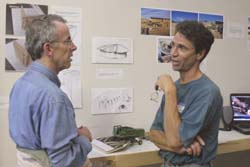
David Ward (rt.)
Photo by Helga Motley
Open House
Photo by Helga Motley

Recognition of our work in the news recently made the front page of the Ashland Daily Tidings. The article is available at: http://www.dailytidings.com/2005/0428/042805n1.shtml.

Milestones for 2004


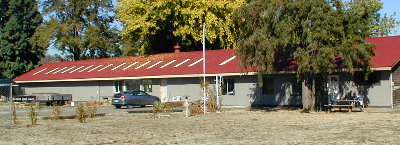
ASET's Facility in Talent Oregon

Talent shop nearing completion Sept. 2004
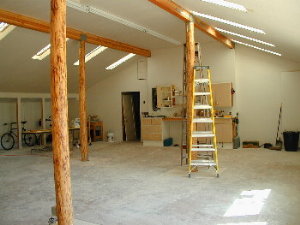
The New Shop

The ASET facility in Talent Oregon is progressing. As of October we are moving into the new workshop area. Other areas of the building will be completed as funds become available.

Prototype Number 3

The focus for 2004 was the third generation prototype. It is designed to integrate several of the functions developed over the past year into one machine capable of producing enough material to build 800 feet of 12 inch thick wall in an 8 hour day. We hope to have the machine ready for limited testing late in the fall of 2004 and fully operational in time for the harvest season in 2005. Other components are being prepared to enable us to produce enough material in 2005 to perform all the testing needed to refine the product and build demonstration buildings.

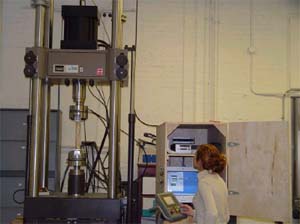
test aparatus at Tulane University
Testing in progress at Tulane University

Testing:

Testing is continuing at Tulane University. Dr. Lamanna has performed compression tests on samples of the Strawcore material which indicate that a wall built out of vertical Strawcore members 2 layers thick (8 inches) would have greater compressive strength than a standard 2x4 stud wall.

Milestones for 2003

Spring 2003 Compression tests were performed on samples of 4x4 beams by Assistant Professor Anthony Lamanna at Tulane University. The sample that was made with damp straw with a clay additive proved to be the strongest, sustaining a load of 3,000 pounds.

Rebuilding the Strawjet machine: Based on the test results, we made some significant changes to the compression and binder portions of the Strawjet machine to accommodate the sticky mix of clay and straw. The result is a more powerful and more versatile machine. The new version is capable of binding plant material that is more resilient. Currently we have experimented with Jerusalem Artichoke and Teasel. While these materials may not be as plentiful or available as surplus biomass, they offer the possibility of making structural material that for use where more strength is required than could be achieved with straw.

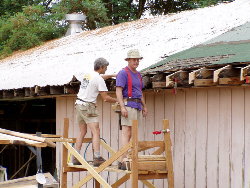
Volunteers preparing to install new roofing and fascia.

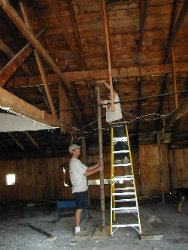
On August 9 ASET purchased a 65% ownership in a building that will give us close to 4,000 square feet of workshop and office space. The acquisition of this space is an essential turning point in the growth of the project. We have been severely hampered by cramped shop space to work during the winter and to work on larger machinery. Currently we are focused on getting some badly needed repairs completed before moving in tools and setting up a functioning shop. Most of the labor has been generously contributed by volunteers, many of them skilled craftsman.

Volunteers repairing the roof structure of the future wood working shop.
IRS Tax Exempt Status was officially granted on August 6, completing our process of establishing ASET as a non profit organization.